Food Manifest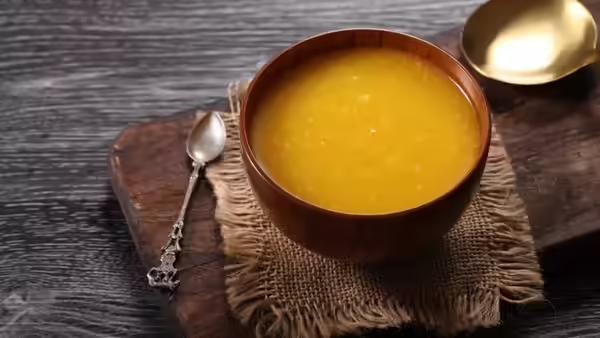
Key Update
A new study has found that beta-carotene, the pigment that gives carrots their orange colour, could help adulterated fats mimic cow ghee and potentially bypass a commonly used authenticity test. Researchers from the Indian Institute of Technology (Banaras Hindu University), Varanasi, showed that palm oil and lard (rendered pig fat) can imitate the Raman spectral signature of genuine cow ghee when mixed with carrot extract rich in beta-carotene. The study was published in the Journal of Raman Spectroscopy.
Concerns Over Ghee Authentication
The findings raise concerns about possible fraud in India’s premium dairy market and highlight limitations in Raman spectroscopy, a testing method widely used to verify food authenticity. Raman spectroscopy works like a molecular fingerprint, helping laboratories identify the composition and purity of a product. The researchers wanted to determine whether the markers commonly used to identify cow ghee could be artificially recreated.
Carrot Extract Mimicked Cow Ghee Markers
Previous studies have identified three beta-carotene peaks as key indicators of authentic cow ghee. To test these markers, the researchers added carrot-derived carotenoids to lard and palm oil samples. The added pigments produced the same Raman peaks typically associated with cow ghee. They also gave the fats a yellow-orange appearance similar to that of cow ghee, making them look and test more like the dairy product. The researchers found that these markers remained detectable even at very low concentrations of carotenoids.
Additional Testing Told a Different Story
To verify the results, the team analysed the samples using Attenuated Total Reflectance Fourier Transform Infrared (ATR-FTIR) spectroscopy. Unlike Raman spectroscopy, FTIR revealed that the underlying fats remained unchanged. The results continued to identify the samples as lard and palm oil, showing that the similarity to cow ghee came mainly from the added pigments.
Researchers Urge Multi-Test Verification
The researchers described the study as an “anti-fraud proof-of-concept” intended to expose weaknesses in existing authentication methods. While they acknowledged the usefulness of Raman spectroscopy, they warned that relying on it alone could leave room for manipulation. They recommended using multiple testing methods to strengthen authentication and protect consumers from potential fraud in the ghee market. Cow ghee carries significant economic and cultural value in India, making reliable authentication essential for both consumer protection and market integrity.
Source: The Hindu