Food Manifest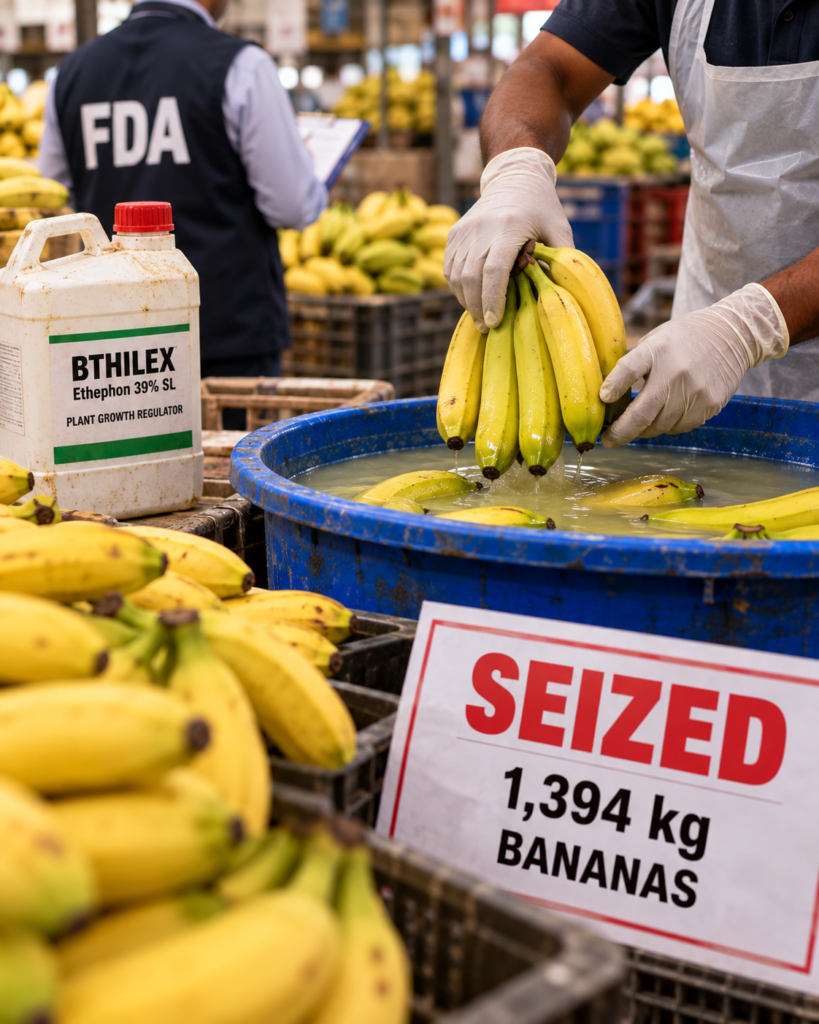
Key Update
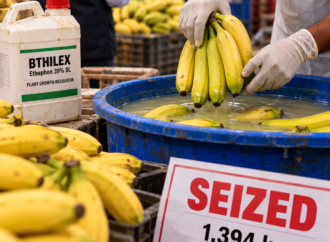
The Food and Drug Administration (FDA) has seized 1,394 kg of bananas worth ₹67,814 from the APMC Turbhe Fruit Market in Navi Mumbai after finding that a seller had dipped the fruit directly in a chemical solution to speed up ripening. Food safety regulations prohibit this practice because it may leave chemical residues on the fruit.
FDA Finds Bananas Dipped in Chemical Solution
Acting on a tip-off, an FDA team inspected stall No. N-919 at the fruit market and found workers dipping bananas in a solution containing BTHILEX (Ethephon 39% SL), a plant growth regulator. According to the FDA, the seller had allegedly prepared the solution by mixing two capfuls of the chemical in five litres of water. Officials seized both the bananas and the chemical during the inspection.
Direct Ethephon Application Is Prohibited
Ethephon may be used to generate ethylene gas for fruit ripening, but workers must not dip fruit directly into an Ethephon solution. Such misuse may leave chemical residues that could pose health risks. The FDA said food businesses may use ethylene gas at concentrations of up to 100 parts per million (ppm) for artificial ripening, provided they follow the procedure prescribed by the Food Safety and Standards Authority of India (FSSAI).
They must use the gas in closed ripening chambers. Food safety regulations also prohibit calcium carbide, commonly called masala, for artificial fruit ripening.
Officials Suspect Unregistered or Counterfeit Chemical
During the inspection, the FDA team found that the BTHILEX packaging lacked manufacturer details and a registration number from the Central Insecticides Board and Registration Committee (CIB&RC). Officials suspected that the product could be counterfeit or unregistered and referred the matter to the concerned department under the Insecticides Act, 1968.
The FDA registered a case at APMC police station in Navi Mumbai under relevant provisions of the Food Safety and Standards Act, 2006, Section 59 of the Bharatiya Nyaya Sanhita, 2023, and the Insecticides Act, 1968. The action follows an FSSAI directive issued on May 15, 2025, which called on states to crack down on unsafe artificial ripening practices involving fruits such as bananas, mangoes, and papayas.
How Can Consumers Identify Artificially Ripened Bananas?
Appearance alone cannot reliably establish whether someone has used chemicals to ripen bananas. However, consumers can watch for certain signs:
- Unusual colour patterns: The peel may look uniformly bright yellow while the stalk remains green.
- Unripe texture: The fruit may remain hard despite its yellow appearance.
- Poor taste: The banana may taste bland or fail to develop its usual sweetness.
- Premature spoilage: Some improperly ripened fruit may spoil sooner than expected.
These signs are not definitive proof of chemical misuse. Consumers should buy bananas from reliable sellers and report suspected unsafe ripening practices to the relevant food safety authorities.
Source: Hindustan Times