Food Manifest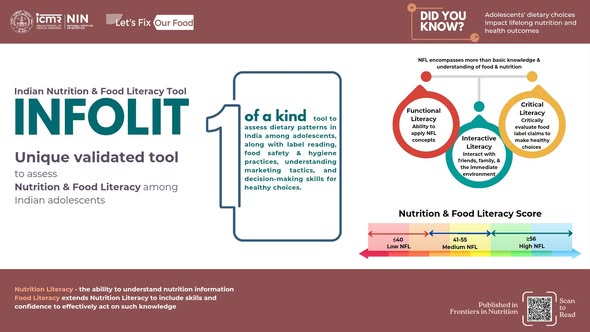
Key Development
With ultra-processed foods and aggressive marketing of high-fat, salt, and sugar (HFSS) products increasingly targeting Indian adolescents, researchers at the Indian Council of Medical Research–National Institute of Nutrition (ICMR-NIN) set out to create a tool that measures nutrition and food literacy among young people.
Introducing INFOLIT
The researchers developed the Indian Nutrition and Food Literacy Tool (INFOLIT) for adolescents aged 13 to 15. INFOLIT bridges a critical public health gap by assessing not just what adolescents know about nutrition, but also how they apply this knowledge to everyday food choices.
Conducting a Rigorous Study
The team tested INFOLIT in Hyderabad among middle-income, school-going adolescents. They used a rigorous five-phase mixed-methods design and conducted psychometric testing with 400 participants to evaluate item difficulty, discrimination, and internal consistency, ensuring the tool’s reliability.
Measuring Knowledge and Skills
After multiple rounds of validation, INFOLIT includes 73 items across two domains. The cognitive domain evaluates adolescents’ nutrition knowledge and understanding, while the skills-based domain assesses how they access, apply, and critically evaluate nutrition information in real-life settings.
Going Beyond Knowledge
Unlike many international tools that focus solely on knowledge, INFOLIT captures both “knowing” and “doing.” It examines food safety, hygiene during preparation, lifestyle practices, interpretation of food labels, and critical evaluation of advertisements. The researchers designed INFOLIT to reflect Indian diets, commonly consumed foods, and local food environments. This cultural relevance ensures the tool accurately represents the experiences and choices of Indian adolescents.
Supporting Education and Public Health
INFOLIT provides a valid, reliable, and culturally appropriate instrument that schools and public health programmes can use. It can strengthen nutrition education, guide interventions, and evaluate policies aimed at improving adolescent dietary habits.
Source: The New Indian Express