Food Manifest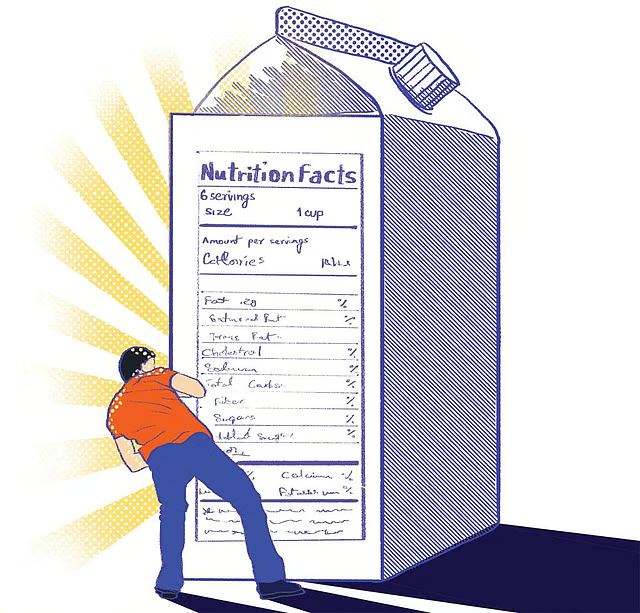
Walk through any supermarket aisle, and you will see packets carrying claims such as “healthy,” “natural,” “multigrain,” “high protein” and “no added sugar.” Yet the information consumers need to assess a product’s nutritional profile often sits in a small table on the back of the pack.
Front-of-pack nutrition labelling (FOPNL) brings some of that information to the front. It presents selected nutritional information in a simplified format, helping shoppers assess a product before buying it. Depending on the system, FOPNL can use warning symbols, colours, stars, ratings or other visual cues. India has been debating which approach would work best for consumers.
What exactly is front-of-pack nutrition labelling?
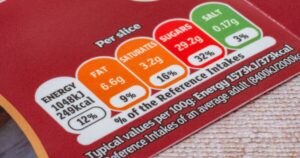
FOPNL presents selected nutritional information on the front of a packaged food, complementing the detailed nutrition panel already required on the package. A conventional nutrition panel can contain several figures, including energy, sugar, fat, sodium, serving sizes and percentages. While useful, these numbers may take time and nutritional knowledge to interpret. FOPNL provides a simpler first layer of information. Instead of requiring shoppers to work through several figures, it highlights key nutritional characteristics in a format designed for quick interpretation.
Importantly, FOPNL is an umbrella term, not a single type of label. Different countries use different systems depending on what they want consumers to notice.
What can appear on the front of a pack?
FOPNL systems communicate nutrition information in several ways. A Daily Intake Guide shows how much a serving contributes to recommended daily nutrient intakes. A traffic-light system combines nutrient quantities with colours such as green, amber and red to indicate their levels.
A warning label takes a more direct approach. It uses a prominent symbol or message to identify products containing high amounts of nutrients such as sugar, salt or saturated fat.
An overall rating system, meanwhile, gives a food stars, points or another score based on several nutritional characteristics. These approaches send different messages. Traffic lights provide both the quantity and a visual interpretation. Warning labels highlight a specific concern, while overall ratings attempt to summarise several characteristics in one score.
Why highlight sugar, salt and saturated fat?
Many FOPNL systems focus on sugar, sodium or salt, and saturated fat because excessive intake of these nutrients can contribute to unhealthy dietary patterns and diet-related health risks. The challenge is that numbers alone do not always communicate their significance.
A package might state that a product contains a certain amount of sugar per 100 grams. Although the information is available, a shopper may not immediately know whether that amount is low, moderate or high. A front-of-pack label can provide that context through a warning, colour or rating, allowing consumers to identify a potential concern without having to interpret several figures themselves.
FOPNL and warning labels: What is the difference?
The two terms are sometimes used interchangeably, but they are not the same. FOPNL is the broader concept; warning labels are one form of FOPNL.
A warning label focuses on a particular nutrient that reaches a level considered high or concerning. An overall rating combines several nutritional characteristics into a single score.
For example, a product may contain fibre or protein while also containing a high amount of sugar. An overall rating could combine these characteristics, whereas a warning label could specifically flag the high sugar content. The choice therefore affects what consumers notice and how they interpret a product.
India’s proposed Indian Nutrition Rating
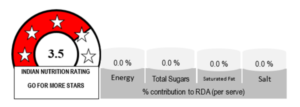
India has already explored an overall rating system.
In its 2022 draft amendment to the Food Safety and Standards (Labelling and Display) Regulations, FSSAI proposed the Indian Nutrition Rating (INR). The system would give packaged foods a rating from ½ star to 5 stars.
The proposed calculation considered energy, total sugar, saturated fat and sodium, while also accounting for positive nutritional components such as fruits and vegetables, nuts, legumes and millets, fibre and protein.
The aim was to give consumers a simple indication of a product’s nutritional profile. Critics, however, questioned whether an overall score could make specific concerns less visible.
A product could receive credit for positive nutritional components while still containing a substantial amount of sugar or sodium. A warning label, by contrast, would draw attention directly to that concern.
What can other countries tell us?
India is not alone in exploring FOPNL. Countries have adopted different systems.
The UK uses traffic-light labelling, Australia and New Zealand use a Health Star Rating, and Chile uses prominent black warning symbols for products high in nutrients such as sugar, sodium and saturated fat.
These experiences have contributed to the evidence around FOPNL. Public-health organisations have pointed to changes in consumer purchasing and consumption patterns following the introduction of warning labels in countries such as Chile. Research comparing different FOPNL systems has also suggested that nutrient-specific warning labels can be particularly effective in helping consumers identify products high in nutrients of concern.
However, no single system automatically works best everywhere. Its effectiveness depends on the design, nutrients highlighted, thresholds used and how easily consumers understand the label.
Why are warning labels being debated in India?
The issue gained renewed attention in 2026. In August, the Supreme Court questioned the Centre and FSSAI over the delay in introducing front-of-pack warning labels for packaged foods high in sugar, salt and saturated fat.
The development has brought the wider FOPNL debate back into focus. India already has the INR proposal, but the current discussion asks whether warning labels would communicate specific nutritional risks more directly. Regulators must decide which nutrients to highlight, what thresholds should trigger a label, which format to adopt and how consumers are likely to interpret it.
What should an effective FOPNL achieve?
An effective FOPNL should present relevant nutritional information clearly, use consistent criteria and help shoppers compare products without complicated calculations. It should also remain a tool for informed choice, not a verdict on a food. No single symbol or rating can capture every aspect of a product or a person’s overall diet.
FOPNL is ultimately about making important nutritional information visible when consumers need it. Whether India chooses warning labels, traffic lights, stars or another approach, the real test is simple: can shoppers look at the front of a pack and quickly understand an important nutritional concern?