Food Manifest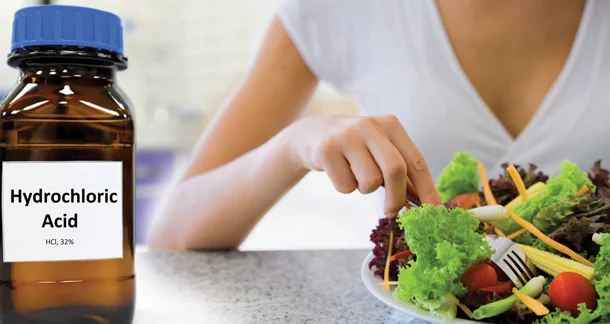
Hydrochloric acid is probably not the first substance that comes to mind when you think about food production. Known for its corrosive properties, this strong acid can cause severe burns on contact with the skin or eyes. Yet, it also has legitimate applications in the food industry. Why would manufacturers use a chemical associated with burns in food processing? Does its use make the finished product unsafe? The answer depends on its purpose, the processing conditions, and compliance with food safety regulations. Understanding these factors helps consumers distinguish between controlled food processing and unsafe chemical adulteration.
What Is Hydrochloric Acid?
Hydrochloric acid (HCl) forms when hydrogen chloride dissolves in water. Industries use it in chemical manufacturing, metal processing, and pH control. Interestingly, the human body also produces hydrochloric acid. The stomach uses it to create an acidic environment that supports digestion and activates enzymes involved in protein breakdown. However, this natural presence does not make concentrated hydrochloric acid safe to handle or consume. Its concentration and exposure conditions determine its risks.
Why Does the Food Industry Use Hydrochloric Acid?
Controlling Acidity and pH
Manufacturers sometimes need to adjust the acidity of a product or processing solution. Hydrochloric acid can lower pH and help achieve the conditions required for specific manufacturing processes. Precise pH control also helps maintain consistent product quality. However, manufacturers must follow the regulations governing each application. Identifying hydrochloric acid as INS 507 does not authorise its unrestricted use in all foods.
Breaking Down Starch
Manufacturers can use acid hydrolysis to break starch into smaller carbohydrate molecules. This process changes starch properties and helps produce ingredients used in food manufacturing. Hydrochloric acid can facilitate this reaction in certain processes. Manufacturers must control processing conditions carefully to achieve the desired results and meet applicable safety requirements.
Producing Hydrolysed Vegetable Proteins
Hydrolysed vegetable proteins provide savoury, umami flavours to soups, sauces, seasonings and other processed foods. Manufacturers produce these ingredients by breaking plant proteins into smaller peptides and amino acids. Acid hydrolysis is one method used, and hydrochloric acid may serve as the processing agent. However, manufacturers must also control potential contaminants that can form during production.
Is Hydrochloric Acid in Food Safe?
Using hydrochloric acid during food processing does not automatically make the finished product unsafe. Equally, its legitimate applications do not make every use safe. Concentrated hydrochloric acid can damage the skin, eyes, and digestive tract. Food manufacturers must handle it safely and use it only under permitted conditions. Where regulations authorise its use, manufacturers must follow applicable purity specifications and good manufacturing practices. They must also comply with relevant residue limits, where prescribed, and ensure that finished products meet food safety standards.
Permission to use a chemical in one application does not automatically authorise its use in every food product. The purpose, food category and applicable regulatory conditions matter.
The Hidden Concern: 3-MCPD Formation
An important food safety concern associated with acid-hydrolysed vegetable proteins is the possible formation of 3-monochloropropane-1,2-diol, commonly known as 3-MCPD. This contaminant can form during certain food-processing operations involving chlorine-containing compounds and fats under specific conditions. Traditional acid hydrolysis of vegetable proteins has been associated with its formation.
Although hydrochloric acid may play a role, its use alone does not establish that a product contains 3-MCPD. Formation depends on factors such as raw materials and processing conditions. Manufacturers can reduce the risk through appropriate processing methods, validated controls, and contaminant monitoring. This highlights an important principle: food safety assessments must consider not only the chemicals used but also potentially harmful substances that may form during processing.
Does Hydrochloric Acid Remain in the Finished Food?
Not necessarily. Its fate depends on the manufacturing process. Hydrochloric acid may react with other substances, become neutralised or be removed during subsequent processing. Therefore, using it as a processing aid does not automatically mean that the finished food contains the acid in its original form. Its use during processing also does not necessarily make the product taste sour.
However, manufacturers must not assume that processing eliminates every possible residue or contaminant. They must ensure compliance with applicable safety requirements.
Why Might It Not Appear on the Food Label?
Consumers may wonder why hydrochloric acid does not always appear on a food label when manufacturers use it during production. The answer depends on its role and the applicable labelling regulations. A substance used solely as a processing aid may qualify for an exemption from ingredient-list declaration under the relevant rules. However, this exemption is not automatic.
A chemical’s absence from an ingredient list does not necessarily mean manufacturers never used it during production. Food additives and processing aids also serve different purposes. Additives perform technological functions in food, while processing aids facilitate manufacturing operations. Their regulatory treatment and labelling requirements may differ.
What Do Indian Food Safety Regulations Say?
In India, the Food Safety and Standards Authority of India (FSSAI) regulates food additives and processing aids under the Food Safety and Standards Act, 2006, and relevant regulations. The Food Safety and Standards (Food Products Standards and Food Additives) Regulations, 2011, establish requirements for food additives, including permitted uses in specified food categories. Relevant provisions also address processing aids. Food businesses must verify the current Indian provisions applicable to their products and processes. Identifying hydrochloric acid as INS 507 does not grant unrestricted permission to use it in all foods.
What Should Consumers Know?
Consumers need not panic simply because hydrochloric acid plays a role in certain food-processing operations. Instead, they should distinguish between a chemical’s hazardous properties in concentrated form and its controlled use in regulated manufacturing. At the same time, the term food-grade does not guarantee safety under every circumstance. Safe use depends on the chemical’s quality, intended purpose, processing conditions, and compliance with applicable regulations.
Ultimately, food safety depends not simply on whether a chemical is used, but on how, why, and under what conditions it is used. Understanding this distinction helps consumers evaluate food safety information without confusing legitimate food processing with unsafe chemical adulteration.