Food Manifest
When you check a nutrition label, the word “sugars” may raise a simple question: Does the number include sugar naturally present in the food, or only the sugar added during processing? The answer lies in understanding the difference between total sugars and added sugars. Although both contribute to the sugar content of a food, they do not mean the same thing. Understanding this difference can help you read food labels more accurately and get a clearer picture of what you are eating.
What Are Total Sugars?
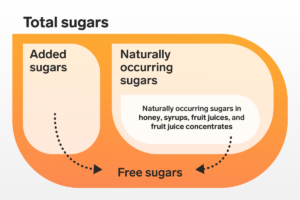
Total sugars refer to the total amount of sugars present in a food. This includes sugars that occur naturally in foods as well as sugars that manufacturers or food producers add during processing or preparation. For example, milk naturally contains lactose, while fruits contain sugars such as fructose and glucose. These naturally occurring sugars contribute to the food’s total sugar content. If a manufacturer adds sugar to a product, that added sugar also contributes to the total.
In simple terms:
Total sugars = naturally occurring sugars + added sugars
Therefore, the total sugar figure alone does not tell you where all the sugar in a food comes from.
What Are Added Sugars?

Added sugars are sugars that manufacturers, cooks or food producers add to foods or beverages during processing or preparation. They can appear in several forms, including sugar, syrups and other sugar-containing ingredients. Products such as sweetened beverages, confectionery, desserts, flavoured dairy products and some breakfast cereals may contain added sugars.
The ingredient list can help you identify whether a product contains added sugar and the forms it takes. This makes the ingredient list an important companion to the nutrition information. While the nutrition panel tells you how much sugar the food contains, the ingredient list can provide clues about the ingredients that contribute to that sugar content.
Why Does the Difference Matter?
Consider two foods with the same total sugar content. One may get most of its sugar from naturally occurring sources, while the other may contain a significant amount of added sugar. For example, plain milk contains naturally occurring lactose. Flavoured milk may contain lactose as well as sugar added during processing. Both products contribute to total sugars, but their sugar sources differ. Looking at both the nutrition information and ingredient list therefore gives you more context than looking at the total sugar number alone.
No Added Sugar Does Not Mean Sugar-Free
The phrase “no added sugar” can sometimes cause confusion. A product can contain sugar even when manufacturers do not add sugar during processing. Fruit-based products may contain naturally occurring sugars from fruit, while dairy products can contain lactose.
Therefore:
No added sugar ≠ No sugar
If you see a “no added sugar” claim, check the nutrition information to see how much total sugar the product contains. The ingredient list can also help you understand where that sugar comes from.
What About Fruit and Fruit Juice?
Whole fruits naturally contain sugars along with fibre, vitamins, minerals and other nutrients. Eating whole fruit also means consuming the fruit in its original form. Fruit juice can also contain naturally occurring sugars. However, processing changes the form in which we consume the fruit. Some packaged juice products may also contain added sugar.
Therefore, do not assume that every product containing fruit contains only naturally occurring sugar. Check the ingredient list and nutrition information to understand what the product contains.
How to Read Sugar Information on a Food Label
You do not need to be a nutrition expert to make better sense of a food label. A few simple checks can give you more information.
Check the Total Sugars
Start with the total sugars listed in the nutrition information. Pay attention to the serving size because the number shown may represent a specific quantity of the product.
A larger serving can provide more sugar than a smaller serving, even when the product itself has not changed.
Read the Ingredient List
Next, check the ingredient list for sugar and other sugar-containing ingredients.
Manufacturers generally list ingredients in descending order by weight. Therefore, the position of a sugar-containing ingredient can provide useful context about its presence in the product.
Consider the Food Itself
Think about whether the food naturally contains sugar.
Milk and fruits, for example, naturally contain sugars. A sweetened version of the same food may contain both naturally occurring and added sugars.
This simple comparison can help you understand why two similar-looking products may have different sugar profiles.
Compare Similar Products
When choosing between similar products, compare their nutrition information and ingredient lists.
Do not rely only on front-of-pack claims such as “no added sugar” or “reduced sugar.” Looking at the complete label gives you a clearer picture of the product.
Common Misconceptions About Sugar
“The total sugars number tells me how much sugar the manufacturer added.”
Not necessarily. Total sugars include both naturally occurring and added sugars.
“If a food contains sugar, someone must have added it.”
Not always. Foods such as fruits and milk naturally contain sugars.
“No added sugar means the product contains no sugar.”
No. The product may still contain naturally occurring sugars.
“Two products with the same total sugar content are the same.”
Not necessarily. Their sugars may come from different sources, and their overall nutritional composition may also differ.
Look Beyond One Number
Understanding sugar content becomes easier when you look at the whole label rather than focusing on a single number. Start with the total sugars. Then check the serving size and ingredient list. Consider the type of food and whether it naturally contains sugar. Finally, compare similar products when you have a choice.
This approach gives you more context than simply looking for the word “sugar” on the label. Understanding the difference between total sugars and added sugars also does not mean you need to avoid every food that contains sugar. Instead, it helps you understand where the sugar comes from and what the label is actually telling you.
The Takeaway
Total sugars tell you how much sugar a food contains. Added sugars tell you about sugar added during processing or preparation. When you read both the nutrition information and ingredient list together, you can better understand a product’s sugar content and make more informed food choices.