Food Manifest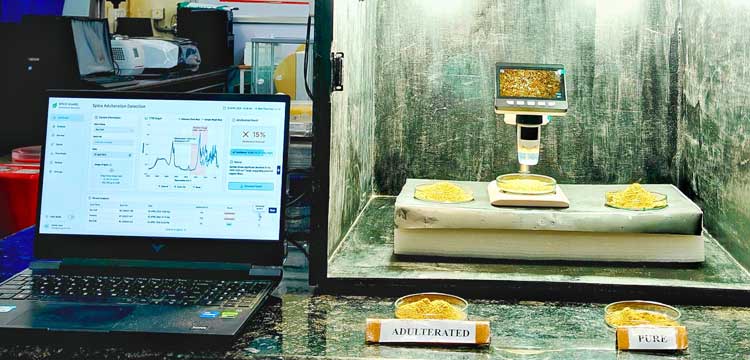
Key Update
Researchers at the National Institute of Technology (NIT) Rourkela have developed and patented an AI-based system that rapidly detects and quantifies adulteration in spices and other food products, offering a faster and more practical alternative to conventional testing methods.
Faster Detection, Real-Time Results
Spice adulteration—often driven by cost-cutting practices—compromises food quality and poses serious health risks. Conventional detection methods, such as chromatography and molecular analysis, deliver accurate results but take time, are more expensive, and require significant resources. These limitations restrict their use in routine and real-time testing.
The new system overcomes these challenges by delivering results within seconds while accurately measuring adulteration levels. It integrates Fourier Transform Infrared Spectroscopy with advanced machine learning models. The system analyses how food samples absorb infrared light and interprets spectral patterns to identify subtle, non-linear irregularities linked to adulterants.
Practical and Scalable Solution
The system offers a non-destructive, cost-effective solution that suits real-time deployment in quality control laboratories and food processing units. It enables faster decision-making and simplifies routine screening processes.
The research team, led by Assistant Professor Sushil Kumar Singh, along with the late Prof Poonam Singha and MTech graduate Rishabh Goyal, published their findings in the journal Food Chemistry. They secured a patent for the invention titled “Method and System for Detecting and Quantifying Adulteration in Food Stuff.”
Proven Accuracy and Industry Relevance
The team tested the system on coriander powder adulterated with sawdust, a common malpractice. The technology achieved around 92% accuracy in detecting and quantifying the contamination. The researchers also developed a broader framework that can identify various adulterants across different food products.
The system fits seamlessly into existing quality control workflows, making it highly useful for routine screening and real-time monitoring. The researchers highlighted its relevance for Indian food businesses, especially spice processors, as it supports checks from raw materials to finished products. Its scalability and affordability make it suitable for both large industries and small and medium enterprises.
Way Forward
The team plans to collaborate with industry partners for pilot-scale studies and real-world validation. They aim to expand the system’s capabilities to detect a wider range of adulterants across diverse food categories.
As food adulteration concerns continue to rise, this innovation strengthens food safety enforcement, improves quality assurance, and builds consumer trust across the supply chain.
Source: Business Standard