Food Manifest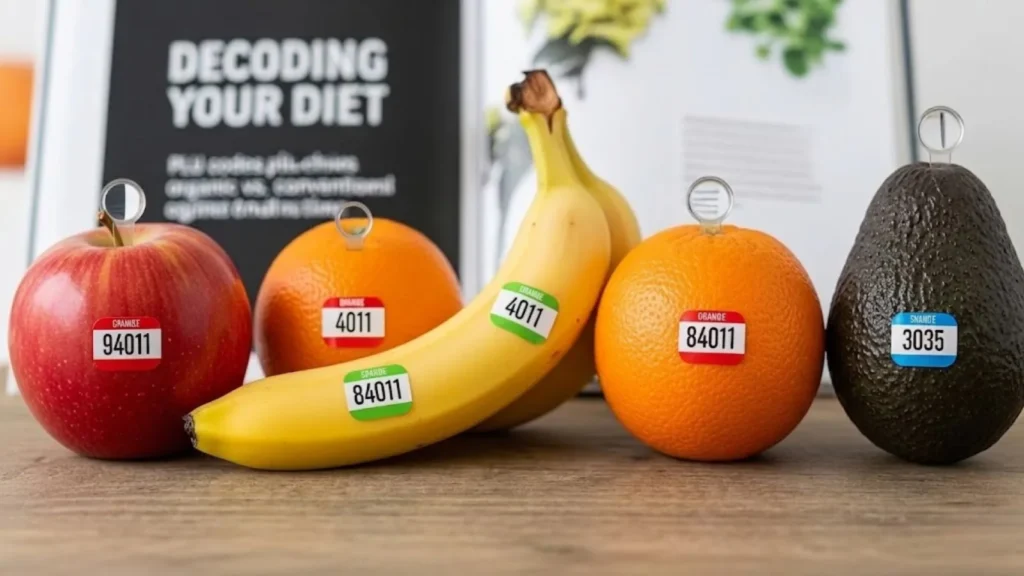
You pick up an apple or a bunch of bananas from a shop. It looks fresh, clean, and ready to eat. Then you notice a small sticker on it—just a few numbers printed neatly. Most of us peel it off without thinking twice. Some people even assume it signals quality, safety, or better farming practices. In reality, these tiny stickers form part of a larger retail system that helps shops identify and price produce quickly. They may look important, but they rarely tell you anything about how safe the fruit is or how anyone handled it before it reached the shelf.
So what are these stickers really?
Shops, supermarkets, and retail systems use these stickers to carry PLU codes (Price Look-Up codes). These numbers help identify fruits and vegetables at the billing counter. For example, when a cashier scans or enters the code, the system immediately identifies the item and applies the correct price. Retailers use this system to speed up billing, track inventory, and manage different varieties of produce. In simple terms, PLU codes work as a retail identification system, not as a food quality label.
What do the numbers mean?
PLU codes usually appear as 4-digit or 5-digit numbers.
- A 4-digit code generally identifies conventionally grown produce.
- A 5-digit code starting with “9” indicates organic produce in some systems.
- A 5-digit code starting with “8” earlier represented genetically modified (GMO) produce, though retailers rarely use it today.
However, the key point remains clear—these codes do not provide universal food safety guarantees. Instead, retailers mainly use them to categorise and manage products efficiently.
What PLU codes do NOT tell you?
This is where most confusion occurs. Many people assume that a sticker on fruit means it is safer or better, but that assumption is not true. PLU codes do not tell you:
- whether the fruit is pesticide-free
- whether anyone handled it hygienically
- whether it is fresher or of higher quality
- whether it is safe to consume
PLU codes do not form part of any food safety certification system. They do not involve testing or inspection. Instead, they only help with billing and identification. So a fruit with a PLU sticker is not necessarily safer than one without it.
Why does this matter in food safety
Food safety is not determined at the billing counter. It is shaped much earlier in the chain, right from farming, harvesting, storage, transport, and handling. Even a perfectly labelled fruit can be exposed to risks like:
- Excess pesticide use
- Poor storage conditions
- Contamination during transport
- Improper handling in markets
This means the real safety of food depends on systems and practices, not stickers or labels. In countries like India, food safety regulation involves agencies, testing labs, and standards that monitor quality. But these checks happen separately from retail coding systems like PLU.
Why consumers get misled
Part of the confusion comes from how people interpret labels in general. In everyday life, people treat labels as signals of trust—whether they see packaged food labels, expiry dates, or “organic” tags. So when people see a sticker on fruit, they often assume it adds an extra layer of assurance. However, PLU codes were never designed to communicate safety or health information to consumers. They exist mainly to improve retail efficiency, not to provide consumer awareness.
The bigger takeaway
Food labels can help people, but they do not always mean what people assume. PLU codes clearly show this gap between perception and reality. They help shops identify produce quickly, but they do not guarantee safety, quality, or cleanliness. So the next time you see a small sticker on your fruit, remember that it serves the shopkeeper’s system and billing process, not as a promise about what you are actually eating.